Thursday, March 12, 2015

LAD #35: FDR's Executive Order #9066

Japanese-Americans preparing for the move into internment camps, authorized by Executive Order #9066
In the Order, FDR authorized military commanders to set up "military areas" (internment camps) in which they could be restricted, and to provide transportation to and food / water / shelter for those areas. They could also take steps as they deemed necessary to enforce Japanese compliance. He directed the other Federal Agencies to aid them in setting up and enforcing the restrictions.

Wednesday, March 11, 2015

LAD #34: FDR's Declaration of War

FDR signing the declaration of war.
The day after the Japanese attack on Pearl Harbor, FDR addressed the nation saying that Japan deliberately attacked America even though they had previously agreed upon peace, and Japan had delivered a message to the Secretary of State that mentioned no hint of a future attack. Since Hawaii was so far away from Japan, it was clear that the attack was planned, possibly weeks in advance. Japan had been deliberately tried to lie to America. Japanese forces also attacked many other places in the Pacific area. He then asserts his certainty that America will pull through, no matter how long it would take. America would not only defend itself, but make sure that an incident like this would never happen again. With God's help, they would triumph over the danger. He asks that Congress declare war on Japan.

Wednesday, March 4, 2015

LAD #33: FDR's First Inaugural Address
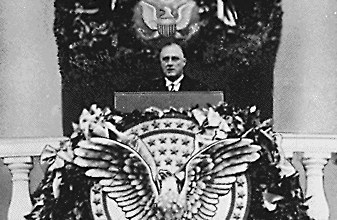
FDR giving his first inaugural address.
FDR opens the speech with his most famous line - "The only thing we have to fear is fear itself." He hopes that people will support him in the hard times America is facing. The difficulties, thankfully, only consist of material things, like money. Though loss of trade and unemployment are big problems, they still had a lot to be thankful for. Much of the problem was caused by money changers, whose thoughts were outdated, and it was time to restore the nation back to being based on social values rather than monetary profit. Also, happiness is not achieved through making money but through achievement, and people shouldn't try to get into high positions just for power and profit.

Restoration calls for action as well; the problem of unemployment could be solved by putting people to work on government projects and at the same time organizing the nation's natural resources efficiently. Talking about it won't help; they must act. In addition, practices such as speculation with other peoples' money and corrupt banking needed to stop.

The nation now realizes its interdependence, that they must act together in order to make any progress. Discipline was the key to getting the nation back on track.

LAD #32: Kellogg-Briand Peace Pact

French statesman signing the Kellogg-Briand Pact.
The pact stated that the signers - United States, Germany, Belgium, France, Great Britain, India, Japan, Poland, and the Czechoslovakian Republic - would no longer turn to war as a national instrument and resolved that peace would be maintained between these countries. They were to condemn war and have all settlements of conflict be carried out peacefully. The pact would also be open to other countries to join, and it would be the duty of America's government to provide joining countries with a copy of the treaty and any necessary instruments they would need to ratify or adhere to it.

Thursday, February 12, 2015

LAD #31: President Wilson's 14 Points

Wilson presenting Congress with his Fourteen Points
Wilson's Fourteen Points were proposed as a way to keep peace after World War I. In the opening, he discusses the conditions of countries like Germany and Russia. At Brest-Litovsk,  Germany was not interested in keeping peace, so Wilson proposed the 14 points in an attempt to make the world safe to live in. The points are summarized as follows:
1. Open covenants of peace
2. Freedom of the seas
3. Removal of economic barriers and establishment of equality of trade
4. Reduction of national armaments to the bare minimum necessary
5. Open-minded adjustment of colonial claims
6. Evacuation and lenient treatment of Russia
7. Evacuation and restoration of Belgium
8. Evacuation and restoration of French territory
9. Adjustment of Italy's borders
10. Allowing Austria-Hungary to self-govern
11. Evacuation and restoration of Serbia, Romania, and Montenegro
12. Secure sovereignty of Turkey and free passage through the Dardanelles
13. Creation of an independent Polish state
14. Establishment of the League of Nations

LAD #30: Schenck v. United States
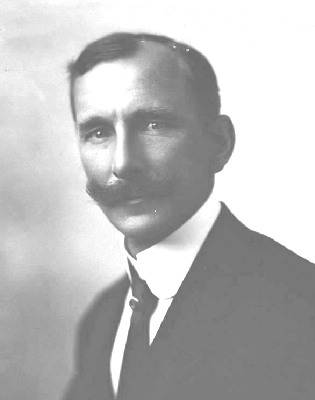
Charles Schenck, a man convicted for obstructing the draft of soldiers into the army.
In Schenck v. the United States, Schenck mailed circulars to draftees that discouraged them from following the draft and joining the army and encouraged them to petition to appeal the Conscription Act. He was charged with violating the Espionage Act and obstructing recruitment. His case was appealed because of suspected violation of the First Amendment / free speech. The decision was unanimous in favor of the United States, with the reason being the character of every act depends on the situation. According to Holmes, in wartime, there is a "clear and present danger" that will stimulate evils Congress needs to prevent, and so certain things that are okay in peacetime can be punished.

Wednesday, January 21, 2015

LAD #29: Keating-Owen Child Labor Act

Two young boys working in a dangerous mill
The discovery that nearly 2 million children were doing dangerous work meant for adults caused a movement to get rid of child labor because of the negative effects on the health of children. The Keating-Owen bill outlawed the employment of children under 14 in most facilities (children under 16 in mines) and required the workdays of children under 16 to be less than 8 hours. Although the bill was passed and signed into law, it was ruled unconstitutional because it "overstepped the purpose of the government's powers to regulate interstate commerce." The Child Labor Tax Law was passed later but also found unconstitutional. Though the nation wanted laws against child labor, the Supreme Court's rulings made it impossible. Though a Child Labor Amendment was proposed, it was stalled by opponents' campaigns. In 1938, the Fair Labor Standards Act was finally passed, passing also the inspection of the Supreme Court in 1941.